Tuesday, September 20, 2022

Sabra And Shatila: A Wound That Won’t Heal


The Sabra and Shatila massacre is one of the many massacres carried out by Israel with the help of Lebanese right-wing parties, which claimed the lives of 3,000 people on a continuous slaughter for three days.

The blood of the martyrs and innocent children who died in the Sabra and Shatila camps in Lebanon will not be washed away after 40 years and the passage of time. 

Allied to the occupation on both the political and military levels, the Lebanese Phalange Party and numerous militias of occupation agents, the Lebanese Phalange Party allied themselves with the occupation. 

Premeditatedly, determinedly, and prepared, since the establishment of the temporary occupation entity in 1948, one of the largest, greatest, and most heinous massacres in Arab-Israeli conflict history has taken place.

There was no specific target for this massacre, but rather it was committed against all human beings. There were also thousands of Lebanese martyrs and martyrs of Arab nationalities.

Sabra and Shatila: The fateful day

On September 16, the occupation army fired flares over the two camps. Three teams of Phalange Party militias, each composed of fifty armed men, stormed the alleyways of the two camps spread over one square kilometer.

To begin the process of extermination and indiscriminate killing, they used white flags and firearms to deceive the residents and ask them to leave the houses with white flags.

The Lebanese Phalange militia killed everyone present in the two camps and mutilated the corpses, slaughtered children and infants, and extracted fetuses from the mother’s wombs. 

They raped many women, robbed them of their jewellery, and killed entire families.

While the occupation army prevented anyone from leaving the two camps, it also prevented the media from entering the area and reporting what was happening.

The families are saying their goodbyes

The massacre took the lives of close to 3,500 Palestinian martyrs over three days and roughly 1900 Lebanese martyrs, in addition to 300 to 500 missing people whose whereabouts are still unknown.

Days passed with the dead still there, and nobody was able to enter the two camps or the nearby communities.

To disassociate itself from the murder, the occupation claimed in a Hebrew book titled “Lebanon 1982 – The Road to War” that the Lebanese Phalange Party carried out the slaughter on its own in retaliation for the assassination of its leader Bashir Gemayel.

Acquittal of Israeli officials

On September 28, 1982, under pressure from the Israeli street, the government of the enemy of Israel was forced to form a committee to investigate “the atrocities committed by a unit of the Lebanese forces against the civilian population in the Sabra and Shatila camps.” It was called the “Kahan Committee,” after the President of the Israeli Supreme Court, Judge Yitzhak. Kahane who chaired the committee.

Kahan’s report, which was issued in February 1983, absolved senior Israeli officials, especially the prime minister, the minister of war, and the army chief of staff, of direct responsibility for the massacre, claiming that they were not aware of what was happening, and denying any role of the Israeli army in the massacre. racism

The report was satisfied with placing personal responsibility on the then Minister of Defense, Ariel Sharon, for ignoring the “possibility of bloodshed and revenge,” which forced him, with mounting pressures, to resign from his position as defense minister only, but he remained a minister without a portfolio.

the fear of the massacre survivors

The occupying power tries from time to time to evade its historical and criminal responsibility for the Sabra and Shatila massacre and to hold the Maronites alone responsible for its implementation, despite the approval in the last lines of the decision to allow them to storm the two camps from the highest levels of Israel. Menachem Begin, Defense Minister Ariel Sharon, Foreign Affairs Yitzhak Shamir, Mossad commander Nahum Admoni, the army Raphael Eitan, the Northern Command Amir Drori, and Military Intelligence Yehoshah Saguh. These decisions could not be overridden, or skipped, which confirms their responsibility for the massacre.


Friday, September 16, 2022

International Tongue Supports Palestine, Hates Normalization!


Israeli steps have recently accelerated in consolidating public normalization with a growing number of Arab and Islamic countries. Since many Arab countries no longer see “Israel” as their enemy, yet their indispensable ally in their war against people and seizing the future of peace, technology and innovation.

While some Arab governments continue to normalize with the occupation “state”, there are Arab countries and positions that have rejected normalization with “Israel” as it entails beautifying and legitimizing the existence of the occupation in Palestinian land.

Political Positions Against Normalization

From Mesopotamia, Iraq records a historic day in support of Palestine and Jerusalem, and the collective position of more than 270 Iraqi parliamentarians, who voted in favor of a law criminalizing normalization with “Israel”. It is a position of victory for Iraq first, then Palestine and Jerusalem second. It also sends a message to the Palestinian people, that Iraq refuses to sell Palestine at a cheap price, and will remain side by side with Palestine, supporting the rights of its people, and criminalizing any form of relationship with “Israel” at all times.

As for Kuwait, it seems that the government and its people are strict in boycotting sporting and commercial dealings with Israel, as the Kuwaiti authorities continue to ban the entry of ships carrying goods to and from Israel into Kuwait’s territorial waters.

Kuwait has emerged as the most Arab country and people whose positions cause concern, confusion and curiosity of Israel, its officials and institutions, especially Jewish think tanks and media.

For his part, Tunisian President Kais Saied Al-Amal included the criminalization of normalization in the new Tunisian constitution issued in the Tunisian Official Gazette on June 30, 2022. In the preface to the text, he referred to “the Palestinian people’s right to their stolen land and the establishment of their state on it after its liberation with its capital, Jerusalem.”

Palestinian Salute to International Positions Against Normalization of Sports


Solidarity march in Morocco with Palestine

A noticeable increase in the number of those who reject sports normalization with the Israeli enemy, with a new group of Arab athletes and solidarity activists from the region joining the ranks of the heroic boycotters who rejected the discourse of “sports for the sake of sport” and “sports above politics”. This record that many international sports associations and institutions did not stop repeating until the trumpets of Arab normalization adopted it and those chasing after some material and moral profits.

With their withdrawal from a number of international tournaments and competitions, the Kuwaitis Muhammad Al-Fadhli, Abdul Razzaq Al-Baghli and Muhammad Al-Awadi, the Jordanians Musa Al-Qutb, Muhammad Al-Saud, Mahmoud Al-Khatib, Ahmed Al-Borini, Muhammad Farhan, Ahmed Al-Batoush, Maysir Al-Dahamshe, Abdullah Shaheen, the Lebanese Aquilina Al-Shayeb, the Algerians Ibrahim Sarqama and Ahmed Touba, in addition to the Iranian Women’s Hockey Team, emphasized one fact that the arenas for resisting normalization with the Israeli colonial and apartheid regime are numerous, and that sport, with its popularity, is on top.


Ons Jabeur, President of the Tunisian tennis champion

We salute the official and popular stances following the insistence of the President of the Tunisian tennis champion Ons Jabeur that her team participate in the Women’s World Cup in Helsinki – Finland from 2-8 February 2020, despite her prior knowledge that the lottery placed it in the same group as the representative team of the Israeli colonial system.

Let us pressure on the Arab sports bodies to raise their voice against the hypocrisy of these Western sports bodies and dominate them, and to demand consistency in policies, and thus the exclusion of Israel in order to end the occupation, settler-colonialism and apartheid regime that has prevailed for more than seven decades.


Ali Farag, the Egyptian squash champion

As the Egyptian squash champion Ali Farag said: […] We were never allowed to talk about politics in sports, but ,suddenly, it is allowed now. As long as it is allowed; then people may look at the oppression happening everywhere in the world. Palestinians are going through this persecution for the past 74 years. […] As long as we can talk now about Ukraine; then we can talk about Palestine as well.

Cultural Boycott

The Price of Normalization: Arab Cultural Works Decide to Exclude Artists Who Were Involved in Normalization Works


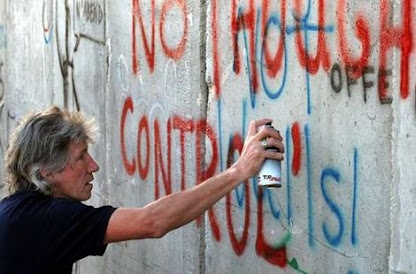
Roger Waters, British rock legend and co-founder of the group Pink Floyd, visits Israeli separation wall surrounding the West Bank town of Bethlehem, 21 June 2006.

As awareness of Israel’s oppression of Palestinians grows, more and more artists from across the world are joining the cultural boycott. Support for the cultural boycott and cancellations of performances receive very significant media exposure in Israel, showing ordinary Israelis that there is increasing opposition to Israel’s denial of Palestinian rights.

Many high-profile artists have cancelled events in ‘Israel’


Lauryn Hill

Top artists including Elvis Costello, Gil Scott-Heron, Lauryn Hill, Faithless, Marianah, U2, Bjork, Zakir Hussain, Jean-Luc Godard, Snoop Dogg, Cat Power, and Vanessa Paradis have cancelled performances in ‘Israel’ or declined to perform there. Despite offering large sums of money to international artists to defy the cultural boycott, Israeli promoters complain that it is becoming increasingly challenging for them to attract famous artists.

Thousands of artists from across the world now support the cultural boycott

Thousands of artists and cultural workers have signed public statements in support of the cultural boycott. In 2015, more than a thousand cultural figures in the UK signed a cultural boycott pledge. BDS-related initiatives have been launched in Montreal (Canada), Ireland, South Africa, Switzerland, Lebanon, and the US. Distinguished cultural figures who have endorsed the cultural boycott of Israel include the late Stéphane Hessel, Holocaust survivor and contributor to the Universal Declaration of Human Rights, Chuck D (pictured left), Roger Waters (pictured above spray painting apartheid wall), Talib Kweli, John Berger, Arundhati Roy, Iain Banks, Judith Butler, Junot Diaz, Naomi Klein, Ken Loach, Alice Walker, Angela Davis, Mira Nair, Mike Leigh and many others.

Tuesday, September 13, 2022

Myanmar’s Genocide On The Rohingya Muslims: An Inspiring Interview With A Heroic Refugee


Authors Note – This week’s article is a special edition as I have collaborated with a Rohingya refugee living in Cox’s Bazaar camp in Bangladesh after fleeing the Myanmar genocide. His name is Jamal Hossain. I have also collaborated with Rohingyatographer Magazine, a unique project created by a team of talented photographers based in Cox’s Bazaar. They have kindly allowed me to share some of their thought-provoking photography. A special thank you to both collaborations.

Over One Million Rohingya Refugees in Bangladesh’s Cox’s Bazaar

Rohingya Muslims are still waiting for justice and the protection of their human rights after the Myanmar military launched a brutal regime of ethnic cleansing in Rakhine State on the 25th of August, 2017. The Myanmar military began a sweeping campaign of massacres, rape and arson against the Rohingya population. Approximately 750,000 Rohingya fled their homes and sought refuge in precarious, flood-type camps in Bangladesh.

Over 1.1 million Rohingya refugees have fled ongoing violence in Myanmar. Many stateless Rohingya live in the world’s largest refugee camp, Cox’s Bazaar, Bangladesh. Many Rohingya say the camp conditions and safety have deteriorated as the humanitarian crisis prolongs. In 2021, aid groups sought nearly $1 billion in donor funding as shortages have grown acute.

Additionally, hundreds of thousands of Rohingya have fled to neighbouring countries by land or boat for many decades due to ongoing violence and persecution. Five years later, the Myanmar government has still not been held accountable for crimes against humanity and acts of genocide. Moreover, an UN-mandated fact-finding mission on Myanmar says abuses and rights violations in Rakhine “undoubtedly amount to the gravest crimes under international law”.

Who are the Rohingya?

The Rohingya are an ethnic group who lived for centuries in Myanmar until the government committed genocide on their population. The Rohingya are known as the “world’s most persecuted minority”.

Myanmar does not recognize the Rohingya as part of its 135 official ethnic groups. Since 1982 they have been denied citizenship in Myanmar, effectively rendering them stateless. Nearly all the remaining Rohingya in Myanmar live in the western coastal state of Rakhine. It is one of the poorest states in Myanmar, with ghetto-like camps and a lack of essential services and opportunities. Refugees are not allowed to leave without the government’s permission.

An Interview With Jamal, A Brave Rohingya Refugee

Who is Jamal?

While researching and writing this article, I had the privilege of interviewing Jamal, a Rohingya refugee currently living in Cox’s Bazar refugee camp in Bangladesh.

Jamal is twenty-years-old and is originally from Myanmar, Rakhine state. In 2017, Jamal and his family fled to Bangladesh and are currently living in an uncomfortable makeshift camp. I am helping Jamal to get his story across to the international community. Jamal works at a local news agency, “The Territorial News”, highlighting the Rohingya histories, cultures and traditions.

The image below shows Jamal helping a 75-year-old Rohingya refugee, Maher Khatun, who is suffering from serious health complications in the camp. The refugees have minimal access to health care services or supplies. Despite Jamal having very little, he talks about how he often brings her to the nearest shop to feed her milk and juices.

Jamal’s Unforgettable Nightmare

On the 25th of August 2017, Jamal and his family fled Myanmar and walked for five days straight until they arrived in Bangladesh. They started living in makeshift camps in Cox’s Bazaar while the World Food Programme provided them with essentials.

Jamal speaks of how he fled from the gunshots and the Burmese military as they eradicated his people.

“My journey was horrible and an unforgettable nightmare. It took me and my family a long time to escape Myanmar and to get safe and sound to Bangladesh. On our way here, we wandered like prey being hunted, hiding in paddy fields and forests, starving for days, and feeding on raw leaves or weeds. Those fields were full of wounded souls, crawling among corpses and blood, just trying to make it towards the safe zone. I often thought: “today is my last day in this world”, but luckily God was beside me, and he wished for me to be alive.”

“They Planted Nightmares in Me, but I Harvested Dreams”

Jamal began teaching children as a freelance volunteer in the refugee camps. Rohingya refugees must stay within the confinement of the camps. In addition, only informal education is allowed for children under the age of 15 years.

Jamal has lost everything his home, country, citizenship, friends, and education. Although they planted nightmares within him, Jamal used this trauma to harvest new dreams for himself. Remarkably, Jamal is brave and optimistic despite everything he has endured. Jamal hopes that one day he will settle down in a peaceful country. In the future, Jamal wishes to become a teacher and continue helping people.

The Lingering Trauma & Deplorable Camp Conditions

Five years later, the Rohingya still face many challenges in Cox’s Bazaar camps. Fires have ravaged many camps, destroying many makeshift homes and personal belongings. Furthermore, severe monsoon floods have made conditions considerably worse. The Rohingya faced COVID-19 challenges with very few resources.

Since August 2017, human rights organizations have interviewed hundreds of refugees living in Bangladesh. They described brutal scenes where Burmese soldiers systematically killed and raped villagers before torching their homes. During the brutal crackdown, the security forces killed thousands of people and burned down nearly 400 villages.

There has been a rise in gender-based violence and reported sexual violence in the camps. A climate of impunity prevails as no formal justice system or accountability measures exist.

Most Rohingya refugees live in camps with population densities of less than 15 square metres per person. This is below the minimum international guidelines for refugee camps.

Moreover, Bangladesh has severely restricted the Rohingya’s livelihoods, movement, and education. Hence, Bangladesh has closed community-based schools, arbitrarily destroyed shops, and imposed new travel restrictions.

International Court of Justice: Genocide Case Against Myanmar

In November 2019, Gambia filed a case before the International Court of Justice (ICJ). The case concerns Myanmar’s alleged genocide against the ethnic Rohingya population in Rakhine State. The Gambian government alleged that the Myanmar military committed the genocidal acts of “killing, causing serious bodily and mental harm, inflicting conditions that are calculated to bring about physical destruction, imposing measures to prevent births, and forcible transfers intended to destroy the Rohingya group in whole or in part.”

The ICJ hearings are the next step in this landmark case to break the cycle of violence and impunity. According to Human Rights Watch and the Global Justice Centre, this case could widely scrutinize Myanmar’s longstanding international crimes.

What is the Rohingya Refugees’ Future?

Myanmar Coup 2021

Prospects for the Rohingya people to return to their land have only grown dimmer following the Myanmar coup in February 2021. This has re-ignited conflicts in Myanmar and worsened the existing humanitarian crisis. The coup has further destabilized Myanmar triggering a nationwide civil disobedience movement.

Since the coup, junta security forces have carried out mass killings, torture, sexual violence, and arbitrary arrests of the Rohingya. Rights groups claim this could amount to crimes against humanity. Additionally, over 1,500 Rohingya were killed since the coup was established. The Rohingya who are currently living in Rakhine State are facing systematic abuses. These abuses amount to crimes of apartheid, persecution, and deprivation of liberty. 

Repatriate or Resettle?

The international community must help either repatriate or resettle the Rohingya people and end this ongoing humanitarian crisis. Moreover, the people in Bangladesh have already suffered enough. Thus, the international community must compensate them for their generosity in welcoming millions of refugees.

Jamal interviewed different community members at the refugee camp who spoke about wanting different outcomes for their futures. Some Rohingya want a dignified return to their land with equal rights and protection measures established. However, whether these protection measures could be effectively introduced remains uncertain. Other community members discuss their wishes to resettle in a third country with new opportunities and fundamental rights.

Final Thoughts

The international response to Myanmar’s ethnic cleansing regime was fragmented and halting. Word leaders preferred quiet diplomacy that achieved little over strategic measures to place real pressure on Myanmar. We must establish a cohesive international response to protect the Rohingya people’s fundamental rights effectively.

We hope for Jamal and all Rohingya refugees that one day they will have a safe and peaceful place to live. As Nelson Mandela once said, “to deny people their human rights is to challenge their very humanity”.

Israel’s Intense Practices to Uproot the Palestinians in Jerusalem

Palestinians experienced the bloodiest and most brutal year of all time in 2022. They witnessed an unprecedented increase in the number of s...